10 Popular Types of Solitaire: Rules, Differences & Which to Try
From the classic Klondike to the fast-paced TriPeaks, there are dozens of Solitaire variants — and each one offers a distinct challenge. Here are 10 of the most popular, fully explained.
Solitaire is not a single game — it is a vast family of card games united by the theme of solo play and card organization. Most people know the classic Klondike version popularized by Microsoft Windows, but that is just one branch of a richly diverse tree. Whether you crave pure logic, fast-paced chain reactions, or mathematical pairing puzzles, there is a Solitaire variant perfectly suited to your style. Here is a comprehensive look at the 10 most popular types of Solitaire, with their rules, what makes each unique, and who will love them most. For historical context, see our article on the fascinating history of Solitaire.

1. Klondike Solitaire (Classic Solitaire)
Best for: Everyone — it is the benchmark all other variants are measured against.
Klondike is what most people picture when they hear the word Solitaire. The tableau consists of 7 columns, dealt in a staircase pattern. Only the top card of each column is face-up at the start. The objective is to build four foundation piles — one per suit — from Ace to King. Tableau moves stack cards in descending order and alternating colors (red on black, black on red). Cards are drawn from the stock one or three at a time.
- Key rule: Alternating colors and descending rank on the tableau; ascending same-suit on the foundation.
- Difficulty: Moderate. Roughly 80% of deals are theoretically winnable.
- What makes it unique: Perfect balance of accessibility and strategy — deep enough to reward skill, easy enough for anyone to start.

Want to sharpen your Klondike game? Our guide on winning Solitaire in fewer moves is the perfect next read.
2. Spider Solitaire
Best for: Players who want a serious strategic challenge.
Spider Solitaire is played with two full decks (104 cards) and 10 tableau columns. The goal is to build complete sequences from King down to Ace — all in the same suit — within the tableau. When a complete sequence forms, it is removed from play. Cards can be moved in any order regardless of suit, but you can only move groups of cards as a unit if they are all the same suit and in proper order.

- Key rule: Complete same-suit sequences from King to Ace to remove them.
- Difficulty: High. The 1-suit version is manageable; the 4-suit version is genuinely demanding.
- What makes it unique: The multi-deck format and suit-sequence requirement create far more complex decisions than Klondike.
3. FreeCell Solitaire
Best for: Logical thinkers who like complete information.
FreeCell is famously one of the most intellectually demanding Solitaire variants. All 52 cards are dealt face-up across 8 tableau columns — nothing is hidden. Four free cells act as temporary parking spaces, each holding one card at a time. The goal is identical to Klondike: build four foundations from Ace to King by suit. The twist is that nearly every deal is solvable — and because all cards are visible, failed games almost always result from poor planning, not bad luck.

- Key rule: All cards face-up from the start; four single-card free cells for temporary storage.
- Difficulty: High strategic depth. Very few deals are unsolvable.
- What makes it unique: Pure strategy with no hidden information — the ultimate test of planning ability.
4. TriPeaks Solitaire
Best for: Players who want fast, satisfying gameplay with mobile-first design.
TriPeaks features a layout of three overlapping peaks of cards, with a waste pile below. The objective is to clear all the cards from the peaks by selecting cards that are one rank higher or lower than the current waste pile card. Chains of consecutive plays create streaks — and streaks are what drive the scoring in most modern TriPeaks apps. TriPeaks rewards quick thinking and flow-state play far more than long-form strategy.

- Key rule: Select cards one rank higher or lower than the waste card; chain plays for maximum streaks.
- Difficulty: Easy to learn, with strategic depth in streak management and wild card use.
- What makes it unique: Faster pace, chain-reaction satisfying combos, and a naturally mobile-friendly format.
TriPeaks is the format behind Solitaire Castle Royal — a beautifully crafted mobile game with hundreds of levels, daily challenges, and gamified rewards. Learn more about why TriPeaks Solitaire is winning over classic fans worldwide.
5. Pyramid Solitaire
Best for: Players who enjoy mathematical pairing puzzles.

In Pyramid Solitaire, 28 cards are arranged in a pyramid shape (7 rows, with the bottom row fully uncovered and upper rows overlapping). The goal is to remove cards from the pyramid by pairing cards whose values sum to 13. Kings (value 13) are removed alone. Queens (12) pair with Aces (1). Jacks (11) pair with 2s. 10s pair with 3s, and so on. Cards from the stock can also be paired with pyramid cards. The game is won when the entire pyramid is cleared.
- Key rule: Pair any two available cards that sum to 13; Kings are removed individually.
- Difficulty: Moderate. Many deals are unwinnable, making wins genuinely satisfying.
- What makes it unique: Arithmetic-based pairing mechanic and the visually distinctive pyramid layout.
6. Golf Solitaire
Best for: Casual players who want quick sessions with simple rules.
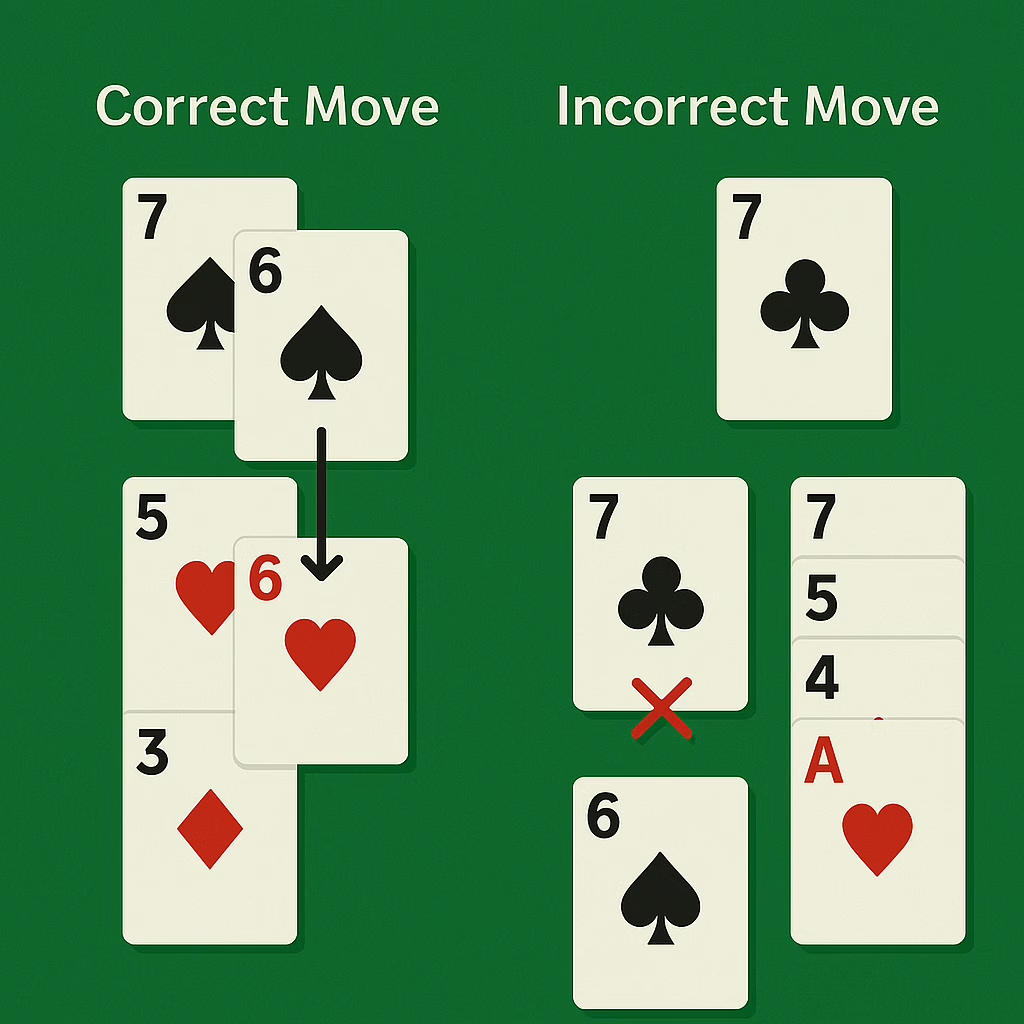
Golf Solitaire deals 35 cards across 7 columns of 5 cards each. Only the top card of each column is playable. The objective is to clear as many cards as possible onto the waste pile by playing cards that are one rank higher or lower than the current top waste card — regardless of suit. Suit is irrelevant; only rank matters. The name comes from the golf-style scoring: the fewer cards left on the tableau at the end, the better your score. Aces are low; Kings are high (wrapping is optional depending on the variant).
- Key rule: Play cards one rank above or below the waste card; suits do not matter.
- Difficulty: Easy. Ideal for a fast, low-stress session.
- What makes it unique: Suit-agnostic play makes it faster and more forgiving than Klondike or Spider.
7. Yukon Solitaire
Best for: Klondike fans who want more flexibility and a tougher challenge.
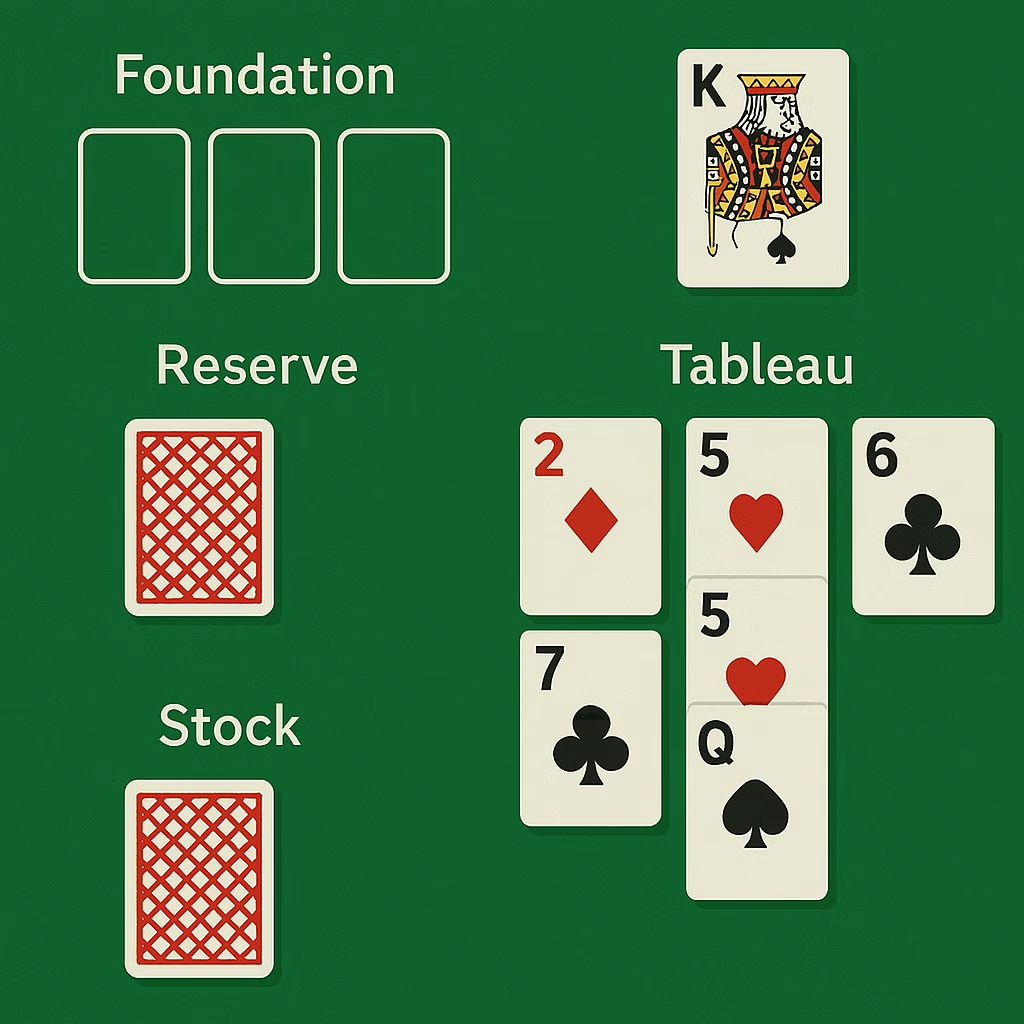
Yukon Solitaire looks like Klondike — 7 tableau columns with a staircase deal — but plays very differently. All cards are dealt face-up from the start (no stock pile). The key difference is that any face-up card can be moved regardless of sequence, taking all cards on top of it along for the ride. This means you can pick up a group of cards that are not in proper sequence order and move them as a unit, as long as the bottom card of the group fits legally on the destination column. This dramatically expands your options — and your potential mistakes.
- Key rule: Any face-up card (and everything above it) can be moved to any legal destination.
- Difficulty: High. Greater flexibility means more paths — and more ways to dead-end.
- What makes it unique: No stock pile, all cards face-up, and completely free tableau movement.
8. Canfield Solitaire
Best for: Players who enjoy a stiff challenge with a historic twist.

Canfield (also known as Demon in some regions) has a fascinating gambling history — it was originally offered at a casino where players bought a deck for $52 and won $5 per card moved to the foundation. The setup: 13 cards are dealt face-down as the reserve stack (top card face-up). One card is dealt face-up to start a foundation, and that rank becomes the base for all four suits. The tableau has only 4 columns of 4 cards each, with builds in descending order and alternating colors. The stock cycles through 3 cards at a time.
- Key rule: Foundation base rank is chosen randomly; all four suits must start at the same rank.
- Difficulty: High. Winning rates are low, which historically made it a compelling gamble.
- What makes it unique: Random foundation start rank and small tableau make it one of the toughest classic variants.
9. Scorpion Solitaire
Best for: Spider Solitaire fans who want a single-deck challenge.

Scorpion Solitaire uses a single 52-card deck and 7 tableau columns. The first four columns receive 7 cards each (top 4 face-down, bottom 3 face-up); the remaining three columns get 4 face-up cards each. Three cards are held back for a final deal. The goal is to build four complete sequences within the tableau from King to Ace, all in the same suit. Movement rules are the most flexible of any variant: any face-up card can be moved to a legal position, and it takes all the cards resting on top of it (even if those cards form no sequence).
- Key rule: Build King-to-Ace same-suit sequences within the tableau; groups move freely.
- Difficulty: Very high. Requires deep planning and careful sequencing.
- What makes it unique: A single-deck Spider-style experience with extremely free movement rules.
10. Accordion Solitaire
Best for: Players who want a unique, compact challenge with no setup overhead.

Accordion Solitaire is a single-row game with a unique compression mechanic. Deal cards one at a time in a row. After each card is placed, you may move it onto another card in the row if: (1) the card immediately to its left matches it in suit or rank, or (2) the card three positions to its left matches it in suit or rank. After a valid move, the row compresses and you look for new moves. The goal is to compress the entire deck into a single pile. Accordion is notoriously difficult to win and requires no special setup — just deal and play.
- Key rule: Move cards onto the card immediately left or three positions left if they share rank or suit.
- Difficulty: Extremely high. Completing the game is rare.
- What makes it unique: A minimalist, self-compressing structure unlike any other Solitaire variant.
Which Type of Solitaire Is Right for You?
Choosing a Solitaire variant depends on your mood, your time, and what kind of challenge you enjoy:
- Quick session (under 10 minutes): Golf, TriPeaks, or Accordion.
- Classic experience: Klondike — always a reliable choice.
- Pure strategy: FreeCell or Yukon — all cards face-up, no luck factor.
- Chain-reaction fun on mobile: TriPeaks Solitaire in Solitaire Castle Royal.
- Hardest possible game: Scorpion or Canfield — for players who love a real fight.
No matter which variant you love, the cognitive health benefits of playing Solitaire apply across the board — focus, pattern recognition, and a calming, meditative flow. If you are ready to try the fastest-growing modern variant, Solitaire Castle Royal brings premium TriPeaks Solitaire to your phone with gorgeous visuals, daily challenges, and hundreds of levels to master.