The History of Solitaire: From Royal Courts to Mobile Apps
Solitaire is about 240 years old. Here is how a quiet European card game went from a 1783 German anthology to Victorian parlors, Windows 3.0 and the phone in your hand.
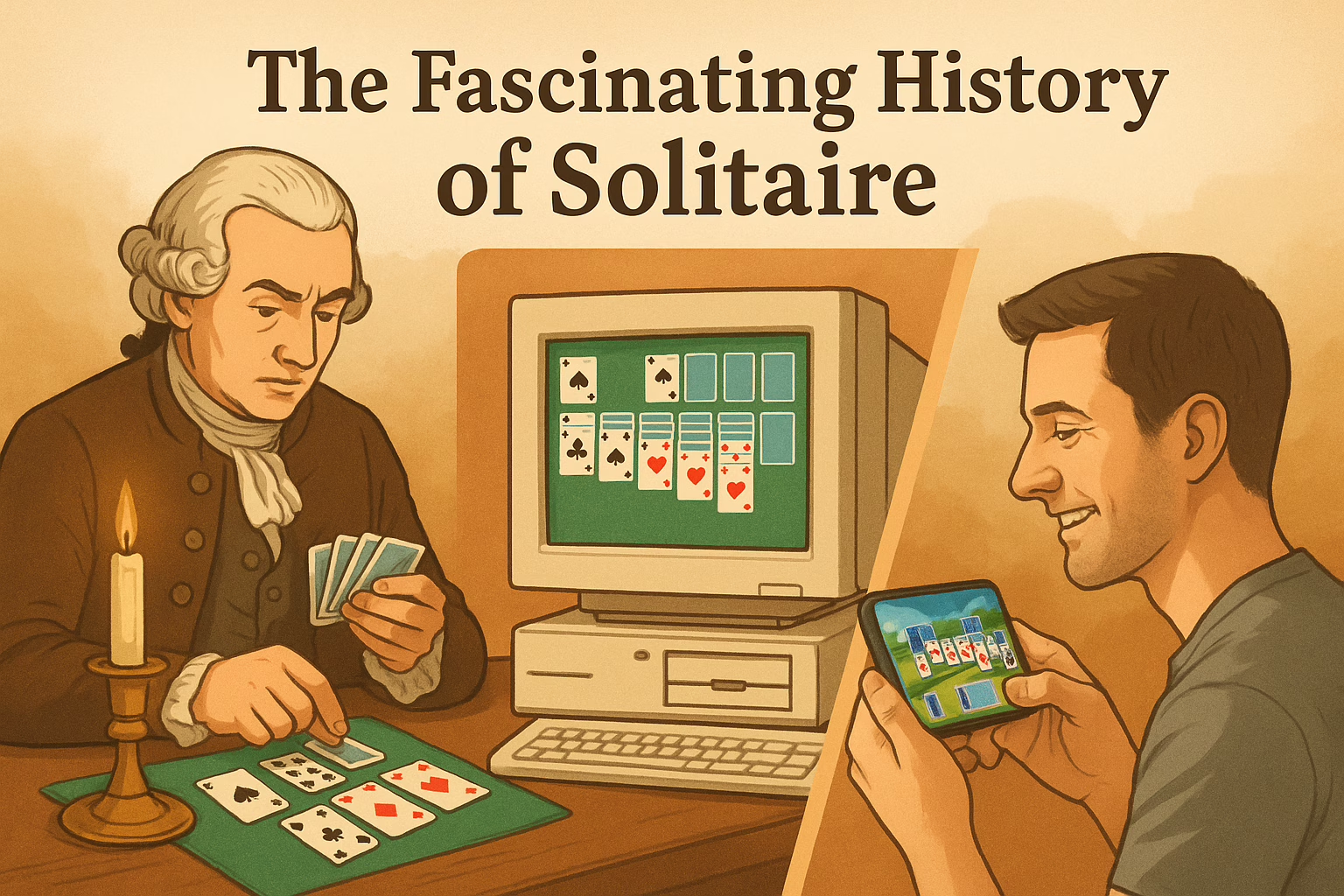
Solitaire first appears in print in Germany in 1783, was collected into English rulebooks from about 1870, turned up under the name Klondike in a 1907 edition of Hoyle, and reached the whole world in 1990 when Microsoft shipped it with Windows 3.0. That is the short version. The long version is more interesting, because at every step the game spread for a different reason: first alongside fortune-telling layouts, then as respectable parlor entertainment, then as a way to teach people how to use a mouse.
The Origins of Solitaire: 18th-Century Europe
Nobody knows exactly where Solitaire began, but the record points to Germany and Scandinavia. According to Wikipedia's history of patience, the earliest known description is in the 1783 edition of a German game anthology, Das neue Königliche L'Hombre-Spiel, and books followed in Sweden and Russia in the early 1800s. The first book devoted entirely to solitaires was published in Russia in 1826. In French the games are called réussite, "success", and in English Patience, which describes both the pace of the game and the temperament it asks for.
The timing hints at a link with fortune-telling. Patience is first mentioned in print shortly after cartomantic layouts, card spreads used to read fortunes, were developed around 1765. The Danish and Norwegian name for the game, kabal, points the same way, and one variant described in 1895 was used only for telling fortunes. None of this proves the games grew out of cartomancy, but the two were laid out on the same tables at the same time.
A popular story says Napoleon Bonaparte played patience during his exile on Saint Helena, and several games carry his name, such as Napoleon at St Helena. Whether he really did is hard to verify: the story is repeated far more often than it is sourced. The names say more about what publishers thought would sell than about Napoleon.
Solitaire in Victorian England and Printed Media
In the 19th century patience moved from a European curiosity to a common parlor game. In Victorian England it was a quiet, respectable pastime that one person could play at home, and the first English-language books on it date from this period.
Lady Adelaide Cadogan's Illustrated Games of Patience, published in about 1870, is often named as the first English collection. Mary Whitmore Jones, whom Wikipedia calls the most prolific and original author on the subject, published her first book in 1888 and had described around 250 games by 1911. Henry Jones, writing as Cavendish, published Patience in 1890.
Printed rules mattered. Once a game was written down with a name, players in different towns could play the same game, argue over the same rules and invent named variants of their own.
Solitaire Crosses the Atlantic
The game reached America by the same route. The earliest American book, Ednah Cheney's Patience: A Series of Games with Cards, appeared in 1869, a year before Cadogan's, and Cheney followed it with a thirty-game volume in 1870.
The variant most of the world now calls simply "Solitaire" is Klondike. According to Wikipedia's Klondike article, the earliest known rules appear in the 1907 edition of Hoyle's Games, under the name Seven-Card Klondike. Some writers tie the name to the Klondike Gold Rush of the late 1890s in Canada's Yukon, and the timing fits, but nobody has found evidence for the connection, and the origin of the name is unknown.
However it got its name, Klondike suited its century: it needs no opponent and no equipment beyond a deck.
The Digital Revolution: Microsoft Solitaire (1990)
The most important moment in Solitaire's history came in 1990, when Microsoft included it in Windows 3.0. Microsoft Solitaire was written by Wes Cherry as an intern in the summer of 1988, with a card deck designed by Susan Kare, who had designed the original Macintosh icons. Microsoft meant it to soothe people intimidated by the new operating system, and dragging cards taught them drag-and-drop with the mouse.
It worked better than anyone planned. Microsoft's own usage data ranked Solitaire among the three most-used Windows programs, with FreeCell seventh, ahead of Word and Excel. Office workers played it between tasks, and a game that had taken two centuries to spread across Europe now came preinstalled on every Windows PC.
The Expansion of Solitaire Variants in the Digital Age
Klondike's success opened the door for other variants. FreeCell first shipped in Microsoft Entertainment Pack Volume 2 in 1991 and became part of Windows itself with Windows 95. Every card is face up and almost every deal can be won, which built it a devoted following. Spider Solitaire arrived in 1998 in the Microsoft Plus! pack for Windows 98, with two decks and suit sequences for players who wanted a harder game.
Developers then brought out Pyramid, Golf, Yukon and dozens more in freeware and commercial software. TriPeaks was invented by Robert Hogue in 1989 and appeared in Microsoft Entertainment Pack 3. Solitaire had become a genre, not just a game. Our guide to the 10 most popular Solitaire variants explains how the main ones differ.
The Mobile Revolution: Solitaire in Your Pocket
Solitaire was an obvious fit for the first handheld devices and keypad phones, where a game that needs only a few buttons and no opponent made sense on a small screen.
The launch of the Apple App Store in 2008 and the explosion of the Android ecosystem created conditions for a true Solitaire renaissance. Touch screens made card-dragging and tapping feel completely natural. Developers could add animation, music and themes that were impractical on desktop. The barrier to entry dropped to zero, because free-to-play games funded by advertising or optional in-app purchases meant anyone could download and play immediately.
Solitaire in the Modern Mobile Era
Today, Solitaire is a thriving mobile genre. Modern apps are rarely plain digital replicas of card games. They carry daily challenges, seasonal events, reward systems, leaderboards and themed art on top of the deal. The psychology is deliberate: streak mechanics, treasure chests, level progression and daily login rewards are all designed to turn a casual time-filler into a habit. It is worth knowing, even if you enjoy it.
Microsoft Solitaire Collection arrived in October 2012 as a free download for Windows 8, which dropped the original game, and it has come preinstalled since Windows 10, so the Windows version is still running more than three decades later. Alongside it, independent developers have mixed Solitaire with match-three mechanics, RPG stories and merge puzzles.
TriPeaks Solitaire has emerged as the format most suited to mobile, because a chain of taps fits a short session better than a seven-column tableau does. Games like Solitaire Castle Royal, which we make, build a kingdom story and 15,000+ hand-built levels on top of that chain.
Solitaire's Cognitive and Wellness Legacy
Solitaire has long been valued as a mental exercise as well as entertainment. A game asks you to hold a plan in mind, spot patterns and think a few moves ahead, and many players describe it as calming: a structured problem to sit inside while a busy mind settles.
What the research does and does not show is a separate question, and the answer is more modest than most app stores suggest. Our article on whether solitaire is good for your brain goes through the evidence.
Why Solitaire Has Lasted Since the 1780s
What is the secret to Solitaire's extraordinary longevity? Several qualities work together:
- Universal accessibility: No language barrier, no opponent needed, minimal equipment.
- Scalable challenge: From simple variants suitable for children to fiendishly complex versions for experts.
- Emotional satisfaction: Finishing a game, especially a difficult one, is a real reward.
- Adaptability: Every new technology platform has welcomed Solitaire naturally, from printed rulebooks to PCs to smartphones.
- Timelessness of the core mechanic: Organizing chaos into order through careful moves is a deeply human satisfaction that never gets old.
From German anthologies of the 1780s to Victorian parlors, office PCs in the 1990s and phones today, Solitaire has moved to every new platform that came along, and nothing suggests it will stop.
The pattern worth noticing is that Solitaire has never needed a marketing push. It spread because it asked for so little: one deck, one person, one flat surface. Every platform since has simply removed another part of that list. If you want the current chapter of it, read why people love TriPeaks Solitaire.