The Real Health Benefits of Playing Solitaire on Your Phone
Solitaire is more than a fun distraction — it is a genuine workout for your mind. Here are the well-established mental and emotional health benefits of playing Solitaire regularly.
Solitaire has been a comfort companion for centuries — played quietly in parlors, on long train journeys, during lunch breaks, and now during the few minutes between meetings on a smartphone. But beyond its undeniable entertainment value, there is a compelling case that playing Solitaire is genuinely good for your mental health and cognitive fitness. This is not about exaggerating a card game into medicine — it is about recognizing the real, well-established ways that structured solo play benefits the brain and the mind.
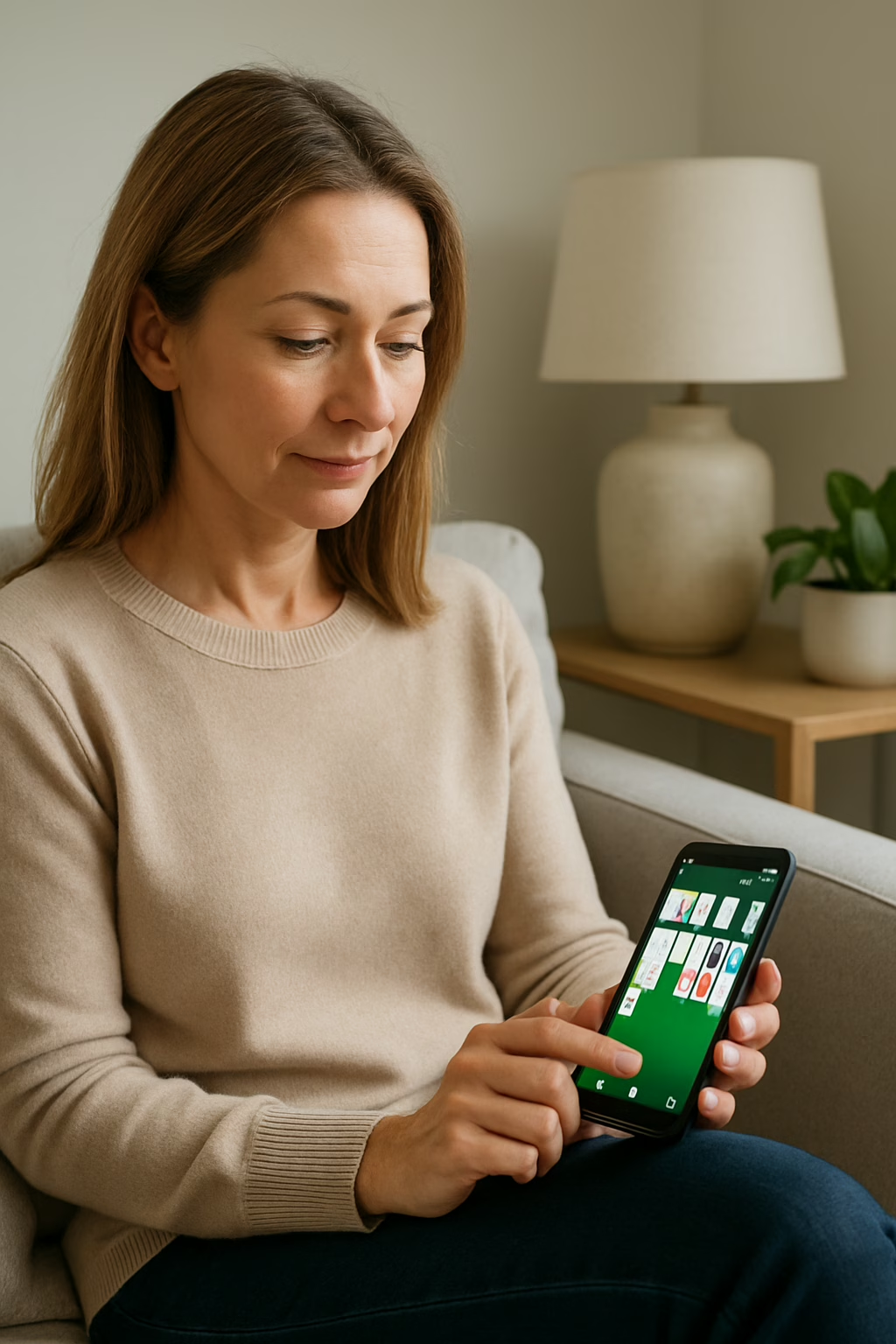
Solitaire has stood the test of time for a reason. Unlike many digital games designed purely around dopamine spikes and social pressure, Solitaire offers something rarer: a calm, focused, low-stakes mental challenge that engages without overwhelming. Here is a full look at the health and wellbeing benefits that make Solitaire — including mobile Solitaire apps like Solitaire Castle Royal — worth your time.
1. Improves Concentration and Focused Attention
A game of Solitaire demands your full attention, even if it does not feel demanding. Tracking card positions, planning legal moves, and anticipating what the next flip from the stock might enable — all of this requires sustained focused attention. You cannot win at Solitaire while half-watching television and only glancing at the cards every few seconds.

This quality of engagement — sometimes called focused immersion — is precisely the kind of attention that many people find difficult to sustain in an era of constant notifications and rapid context-switching. Playing Solitaire regularly provides consistent practice in staying focused on a single task for an extended period. Over time, this trains the attentional systems that underpin concentration in other areas of life.
2. Builds and Exercises Short-Term Memory
Effective Solitaire play involves remembering where specific cards are located — which face-down pile contains the card you need, which cards have already passed through the waste pile, and which suits are running ahead or behind on the foundations. This is active memory work, not passive consumption.

Short-term (working) memory is one of the cognitive functions most associated with overall mental sharpness. Keeping it exercised through engaging, game-based challenges is widely regarded by cognitive researchers as a more effective approach than passive memory drills. Because Solitaire presents a new memory challenge with every deal, the engagement is always fresh.
3. Develops Strategic Thinking and Planning
Every move in Solitaire is a decision, and many of those decisions have cascading consequences. Should you send that 4 of hearts to the foundation now, or keep it on the tableau where it is blocking a face-down card? Do you fill the empty column with a King immediately, or wait for a better sequence to emerge? These are genuine strategic planning questions with real consequences within the game.

This kind of consequential decision-making under uncertainty is a cognitive skill with broad applications — from work planning to personal finance to any context where actions have downstream effects. Solitaire provides a low-stakes sandbox in which to practice thinking ahead, evaluating trade-offs, and learning from outcomes. Read our guide on winning Solitaire in fewer moves to understand just how deep this strategic layer goes.
4. Provides Genuine Stress Relief
Stress relief through games sounds like a marketing claim, but there are solid psychological reasons why Solitaire works as a stress management tool. The game offers what psychologists call a structured distraction — it is engaging enough to redirect attention away from anxious thoughts, but not so demanding that it creates its own stress.

The repetitive, rhythmic nature of card play — drawing, evaluating, moving — creates a gentle cognitive loop that many players describe as meditative. Unlike high-adrenaline action games or competitive social games that trigger performance anxiety, Solitaire is a private, low-pressure experience. There is no one to judge your play, no real-time opponent to beat, and no consequence beyond the game itself.
This quality makes Solitaire particularly valuable during transitional moments — the few minutes between stressful meetings, the winding-down period before sleep, or the commute that would otherwise be spent doom-scrolling. The gentle engagement of Solitaire can act as a mental reset that leaves you calmer and more focused than passive social media browsing.

5. Cultivates Patience and Emotional Resilience
The original name for Solitaire in English — Patience — is not an accident. The game inherently rewards a patient, deliberate approach and penalizes impulsive play. A player who rushes through moves without thinking typically loses faster; a player who takes their time, evaluates options, and accepts that some deals will not work out builds genuine emotional tolerance for uncertainty and setback.
This is a legitimate psychological benefit. Learning to sit with a problem, try approaches methodically, and accept outcomes without frustration — skills trained naturally by repeated Solitaire play — are components of emotional resilience. The game's structure normalizes the experience of encountering a difficult situation, working through it thoughtfully, and sometimes finding that it simply cannot be resolved despite best efforts. That is a healthy mental model for life in general.
6. Enhances Pattern Recognition
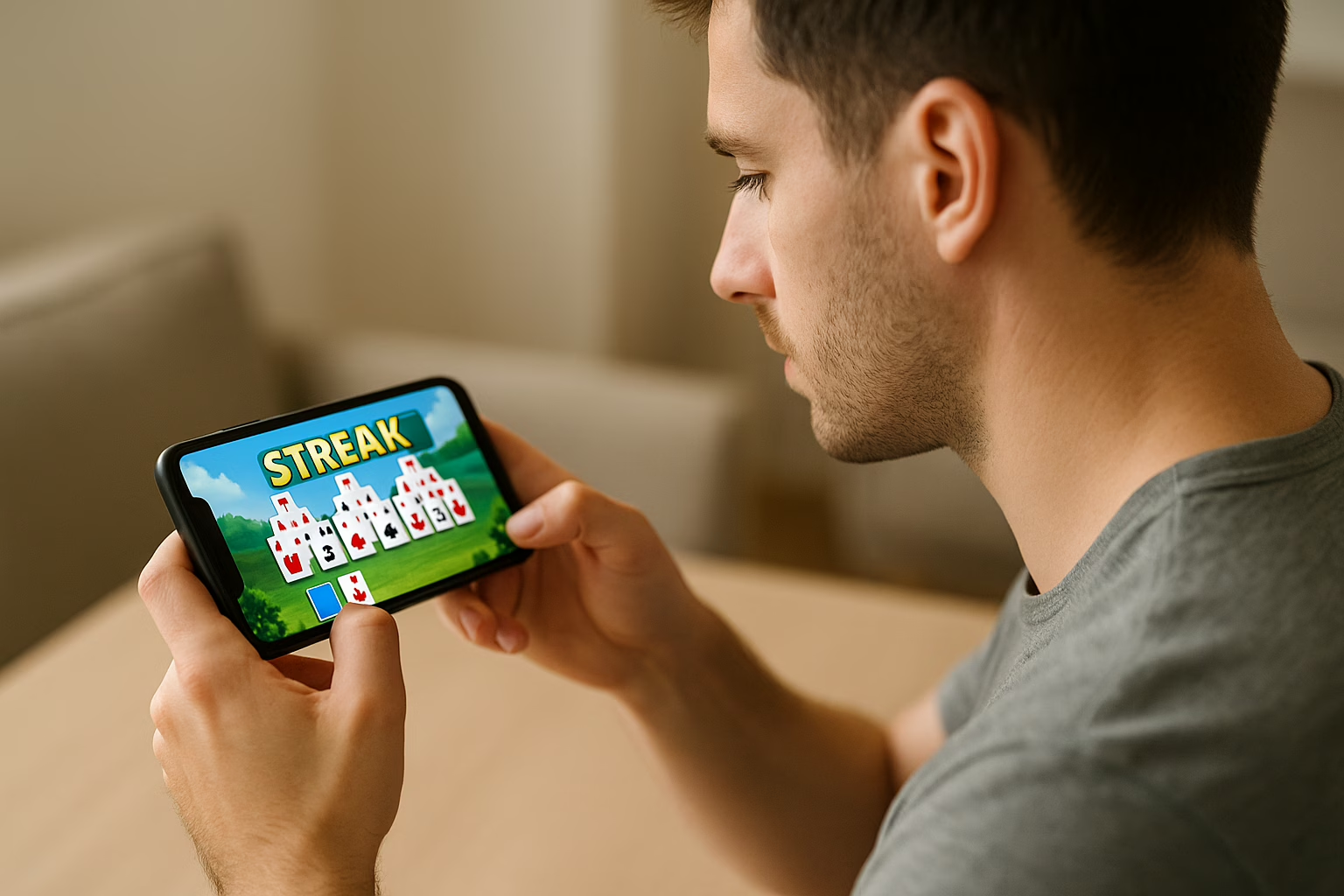
Experienced Solitaire players develop an eye for card patterns that beginners do not have. They quickly recognize dangerous board configurations, spot opportunities for multi-move sequences, and instinctively evaluate which moves are likely to help or harm their position. This visual pattern recognition improves with practice and is a cognitive skill that transfers to many other domains.
Pattern recognition is foundational to reading comprehension, mathematical reasoning, artistic perception, and many professional skills. The fact that developing it through a card game is enjoyable rather than laborious makes Solitaire an unusually pleasant form of cognitive exercise. Different Solitaire variants sharpen different aspects of this skill — explore our guide to 10 types of Solitaire to find the variant that challenges you most.

7. Supports a Calming Bedtime Routine
The blue-light concerns around screen use before sleep are legitimate, but the type of content matters at least as much as the light itself. High-stimulation games, social media, and news feeds engage the brain's threat-detection and social-comparison systems in ways that are genuinely disruptive to sleep onset. Solitaire, by contrast, engages the problem-solving mind in a calm, low-stakes way — more comparable to a gentle puzzle than to a social stimulus.
Many players report that a short Solitaire session in the evening helps them decompress and transition out of work mode, providing a mental bridge between the day's demands and restful sleep. The key is keeping the session genuinely calm — not chasing a win compulsively, but enjoying the quiet rhythm of the game. Solitaire Castle Royal is specifically designed for this kind of relaxing, session-paced play.

8. Accessible Cognitive Engagement at Every Age
One of Solitaire's most important qualities is its age-inclusive design. The basic rules of Klondike or TriPeaks can be learned by a child; the strategic depth can genuinely challenge adults and older players for a lifetime. This makes it one of the few games that provides meaningful cognitive engagement across a very wide age range.
For older adults, in particular, regular engagement with games that require planning, memory, and decision-making is associated with maintaining cognitive vitality. Solitaire checks all of those boxes while remaining enjoyable and pressure-free — qualities that matter enormously for sustained engagement. The game's portability on smartphones means it is available to virtually anyone at any time.

9. Encourages a Healthy Digital Activity
Not all mobile time is created equal. Research into screen time increasingly distinguishes between passive consumption (scrolling feeds, watching videos) and active engagement (problem-solving, creating, strategizing). Solitaire clearly falls into the active engagement category. Rather than absorbing a stream of external content, the Solitaire player is actively making decisions, holding information in memory, and planning ahead.
This makes Solitaire a genuinely healthier choice of mobile activity for those short windows in your day where a screen is going to be out anyway. Choosing Solitaire over social scrolling is a meaningful difference in how that time affects your mind. Solitaire Castle Royal is built around this philosophy — short, satisfying, skill-building sessions that leave you feeling good rather than drained.

10. Delivers the Satisfaction of Completion
Winning a game of Solitaire — particularly a difficult one — delivers a genuine sense of accomplishment. This is not trivial. Completion satisfaction is a meaningful psychological experience: the feeling that a problem was engaged with, worked through, and resolved. In a world where many tasks feel endless or ambiguous, a card game with a clear win condition offers a clean, satisfying arc.
Even losing deals offer a version of closure: the deal played out, you worked with what you had, and the outcome is clear. There is no unfinished business. This psychological cleanliness — a beginning, middle, and definitive end — is part of what makes Solitaire feel satisfying in a way that open-ended social media feeds do not.

Playing Solitaire Mindfully
The benefits described above emerge most fully from mindful, engaged play — not from compulsive gaming or marathon sessions. Here are a few simple guidelines:
- Set a time limit before you start and stick to it. Five to fifteen minutes is often ideal.
- Play without multitasking. The cognitive benefits come from focused engagement.
- Accept difficult deals philosophically. Some configurations are unsolvable — that is part of the game, not a failure.
- Appreciate the process, not just the outcome. The strategic thinking during play is where most of the benefit lies.
- Use Solitaire as a deliberate break activity, not a default screen habit.
Ready to put these principles into practice? Solitaire Castle Royal is designed for exactly this kind of mindful, enjoyable play — with a beautiful visual design, hundreds of thoughtfully crafted levels, and the satisfying chain-play mechanics of TriPeaks Solitaire. Discover more about why TriPeaks is winning over Solitaire fans worldwide, or learn about the rich history behind the game you are already enjoying.